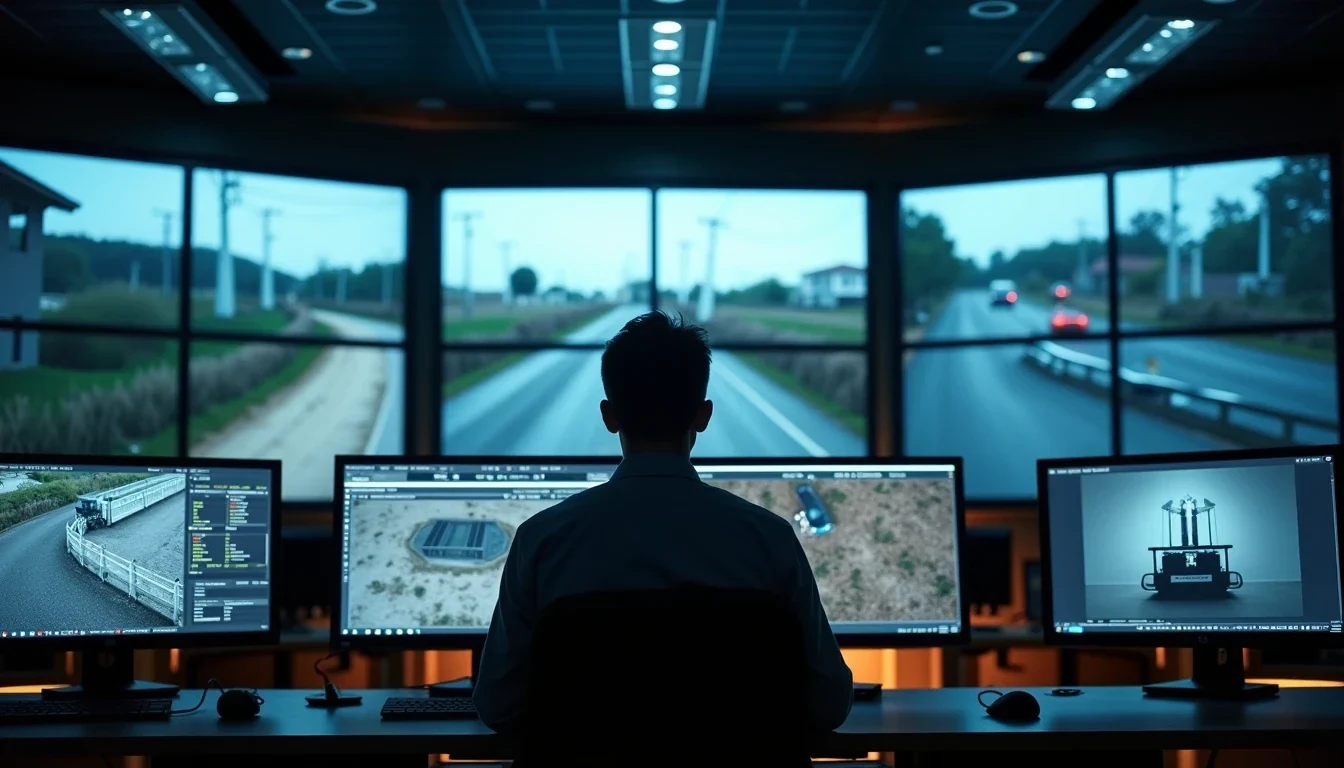
A high-stakes baccarat table in Sandton can see more cash move across felt in an hour than most bank branches handle in a week. The people protecting that flow do not rely on a single gadget or gatekeeper. They build rings of defence, each layer watching the others, each system capable of catching what the last one missed. The modern casino floor is less a gambling hall than a controlled environment where every transaction, movement, and face is logged, compared, and archived in real time.
This defence-in-depth architecture starts long before a patron reaches the slot machines. It begins at the property line, runs through the parking structure, into the back-of-house corridors where cash becomes digital ledger entries, and back out to the gaming floor where algorithms read faces faster than any pit boss could.
The Perimeter as First Warning System
Casino operators learned long ago that reactive security arrives too late. A guard who responds to an alarm is already behind. The perimeter fence exists to create time, distance, and noise, converting the outer boundary into an active sensor grid rather than a passive barrier.
Electric fencing dominates this layer across high-security commercial properties in Gauteng, KwaZulu-Natal, and the Western Cape. The technology carries particular weight in environments where vehicle syndicates operate with speed and coordination, using lookouts and rapid entry tactics to target high-value targets. An electrified perimeter detects as well as blocks. Each zone of the fence operates as an independent circuit. Cut a strand, short it against metal, or attempt to ground it out, and the energizer registers the change in resistance immediately. The central control room receives the alert before an intruder has cleared the wall. Linked PTZ cameras then slew automatically to the triggered coordinates, delivering live video to operators who can assess the threat and dispatch armed response without the delay of human patrol verification.
The psychological effect operates in parallel. Opportunistic criminals scout targets, and a visibly electrified perimeter with proper warning signage alters the risk calculation. The fence does not need to deliver a shock to serve its purpose. It needs to be seen, understood, and factored into the decision to move elsewhere.
Casinos face a constraint that warehouses and industrial parks do not. The parking lot is part of the customer experience. Raw palisade or aggressive free-standing fencing sends the wrong signal to guests arriving for an evening out. Operators solve this by mounting electrified strands discreetly on existing masonry walls, often behind architectural finishes that preserve the property’s aesthetic. Where clear-view or stylised palisade fencing is used, the electrification integrates into the design rather than dominating it. Free-standing electric fencing, with its more utilitarian appearance, is reserved for back-of-house areas, vehicle depots, and delivery yards where operational efficiency outweighs visual welcome.
This balance between deterrence and hospitality reflects strict regulatory requirements that govern every aspect of electric fence installation in commercial environments.
Compliance as Engineering Constraint
The South African Occupational Health and Safety Act and the SANS 10222 and 10400 standards treat electric fencing with precision. They specify pulse characteristics, mounting heights, signage density, and installation methods with little room for interpretation.
Energizers in urban casino zones must deliver regulated intermittent pulses capped at 8 Joules. This limit provides sufficient deterrent force while preventing lethal consequences, which would expose operators to civil liability and criminal charges. Wall-mounted electric wires must sit between 1.5 and 1.8 metres above ground level, a height calculated to prevent accidental contact by pedestrians while remaining effective against deliberate intrusion. Yellow warning signs are mandatory at every access point and gate, with additional signage spaced no more than ten metres apart in built-up environments where foot traffic concentrates.
One prohibition carries particular weight. Directly electrifying razor wire or barbed wire is strictly illegal in commercial and urban zones. Installers who ignore this rule violate standards, void the property’s insurance coverage, and expose the casino to regulatory sanction. A valid Certificate of Compliance from a registered Electric Fence System Installer is required to maintain that coverage, and gaming facilities treat this documentation with the same seriousness they apply to their gaming board licences.
The maintenance burden is continuous. Energizers degrade, vegetation encroaches, and signage fades. A perimeter that passed inspection in January may fail in July if a tree branch bridges two strands or a rodent chews through an earth lead. This operational reality drives many casino operators toward specialist maintenance providers. Routine inspection and repair contracts ensure that the first layer of defence does not silently fail between audits. For properties managing multiple integrated systems, the complexity of maintaining compliant electric fencing alongside access control, surveillance, and alarm networks often exceeds in-house capacity. Specialist firms including Onepoint Security handle these integrated maintenance programmes, preserving both operational readiness and the documentation trail that insurers and regulators require.
Biometric Gates to the Inner World
Beyond the perimeter, the casino divides into zones of escalating sensitivity. The public floor, with its open slots and table games, operates under one security regime. The back-of-house corridors, cash rooms, counting rooms, surveillance booths, vaults, and executive offices operate under another entirely.
Access to these restricted areas demands multi-factor authentication that combines possession and identity. Smart cards or mobile credentials establish that a user carries authorised credentials. Biometric verification, fingerprint, facial recognition, or iris scanning, establishes that the credential belongs to the person presenting it. Neither factor alone opens the door. A stolen card without the matching fingerprint is worthless. A severed finger, Hollywood fantasies aside, fails against modern liveness detection algorithms.
Door-contact sensors track every entry and exit in real time, creating a digital log permanently tied to the user credentials that triggered it. This audit trail serves multiple masters. Gaming board inspectors demand it. Statutory auditors examine it. Internal security teams mine it for anomalies: the cashier who accesses the count room outside shift hours, the supervisor who tailgates through a door without independent authentication, the maintenance worker whose credential appears in two locations simultaneously.
The granularity of this logging shapes behaviour. Staff know that every door event is recorded, archived, and searchable. The knowledge alone reduces casual policy violations. The system prevents the rationalisation that leads to offending.
The All-Seeing Floor
Camera coverage in modern casinos achieves a density that would have been impractical a decade ago. High-resolution fixed cameras maintain constant watch over defined zones. PTZ units provide dynamic tracking capability, responding to operator commands or automated triggers. Covert mini-domes blend into ceiling architecture, capturing angles that visible cameras cannot.
The hardware is only the substrate. The intelligence runs in software layers, both on-board the cameras themselves and on central servers that aggregate multiple streams. This AI-driven analytics engine performs continuous pattern recognition across the entire field of view. It flags loitering in areas where stationary presence suggests reconnaissance or preparation. It identifies left-behind objects that could indicate anything from a forgotten handbag to a planted device. It detects behavioural anomalies at table games: the dealer who deviates from procedure, the player whose betting patterns correlate suspiciously with shuffle sequences, the bystander who positions for an angle on another player’s hand.
The count room receives particular algorithmic attention. This is where cash becomes accountable, where the physical chips and bills of the gaming floor transform into ledger entries. Any deviation from standard operating procedure, any unauthorised movement, any absence where presence is required, triggers immediate alert. The system knows what normal looks like because it has observed thousands of hours of normal. It notices the exception.
Integration between video and access control amplifies both systems. When a door alarm triggers, operators do not merely see that Door 7B opened at 03:47. They see the video feed synchronized to that moment, the credential that authorised the opening, and the face of the person who passed through. Context collapses the time between alert and understanding. A door forced without credential presentation produces one response. A valid credential followed by an unexpected second person produces another. The merged data stream enables differentiated response rather than uniform panic.
Faces in the Database
Facial recognition operates as a specialised layer atop the general video analytics. Its purpose is identification rather than anomaly detection, matching live captures against curated databases of known individuals.
The watchlists serve distinct regulatory and operational purposes. Self-excluded gamblers have voluntarily requested exclusion from casino premises, and operators who fail to enforce these requests face regulatory penalty and civil liability. Known cheats have demonstrated methods that statistical surveillance might miss but human recognition could catch. Banned individuals include those whose previous conduct, criminal association, or debt history makes their presence unacceptable.
Modern deployments address two constraints that plagued earlier systems: latency and privacy. Edge-processed cameras perform facial comparison locally, on the camera hardware itself, rather than transmitting raw video to remote servers for analysis. Local matching architectures keep biometric data within the casino’s controlled network perimeter. Both approaches reduce the time between a subject entering the field of view and a match alert reaching security personnel. They also limit the exposure of sensitive biometric data to external networks, addressing data protection requirements that have tightened considerably as facial recognition has proliferated.
When the system finds a match, the response is deliberately quiet. Silent alarms activate. Pager or mobile notifications reach floor security and surveillance teams without alerting the subject or disturbing surrounding patrons. The goal is interception without confrontation, resolution without spectacle. A known cheat escorted to a private room for identification verification creates less disruption than a public accusation that might prove erroneous.
The Insider Threat
External criminals present one risk profile. Employees present another, often more costly one. Internal shrinkage, the euphemism for theft by staff, accounts for significant losses in gaming operations worldwide. The casino’s response is to make the employee environment as surveilled as the patron environment, with additional controls tailored to workforce management.
Role-Based Access Control limits credentials to specific physical areas and time windows. A cashier authorised for the cage during the day shift receives no access to the count room at night. These restrictions are enforced by the same multi-factor authentication that protects the most sensitive zones. The system cannot be sweet-talked, bribed, or confused by a uniform change.
Biometric timekeeping closes another vulnerability. Fingerprint or palm-vein terminals for clock-in and clock-out eliminate buddy-punching, the practice where one employee scans another’s credential to disguise absenteeism or unauthorised overtime. The biometric record links irrefutably to the individual, creating a personnel movement log that cross-references with access control and video data.
The most powerful control is the cross-reference itself. When a staff member performs a drop box collection, a chip count, or a cash fill, the system preserves multiple independent records. Video shows the action. Access logs show who entered the area. Biometric timekeeping confirms presence. Discrepancies between these records, a chip count that does not match the video record of chips handled, a cash fill that does not align with the access log of who performed it, surface automatically for investigation. The architecture assumes that any single record might be corrupted, falsified, or misinterpreted. The correlation across independent systems creates reliability.
Maintenance as Security Doctrine
Every system described here degrades without attention. Cameras drift out of focus. Biometric sensors accumulate skin oils and environmental grime that reduce accuracy. Electric fence energizers suffer component fatigue. Software requires patching against discovered vulnerabilities. The perimeter that deters today may merely annoy tomorrow if a tree branch provides a bridge or a ground rod corrodes.
This maintenance imperative extends beyond technical function to regulatory and insurance standing. A biometric system that fails to log entries creates an audit gap that gaming inspectors will notice. An electric fence without current Certificate of Compliance documentation exposes the operator to coverage denial if an incident occurs. The integrated nature of modern casino security means that failure in one system propagates. For example, a camera outage prevents verification of an access alarm, or a fence alert cannot display associated video because the PTZ unit failed.
The operational rhythm of a large gaming property, with its 24-hour operations, multiple entry points, and constant cash movement, does not accommodate extended downtime for system maintenance. Specialist providers who understand both the technology and the regulatory environment become essential infrastructure partners. Their value lies not merely in repair capability but in preventive programmes that identify degradation before it becomes failure, and in documentation practices that satisfy auditors and insurers without administrative burden on casino operations staff.
The Architecture of Distrust
What emerges from these layers is not merely a collection of security technologies but a philosophy of operation. The modern casino assumes that every participant, patron and employee alike, might act against the house interest. It does not rely on trust. It relies on verification, correlation, and immutable record.
This architecture carries costs. The capital investment in multi-factor access control, AI-driven surveillance, facial recognition infrastructure, and compliant perimeter electrification runs to millions of rands for a major property. The operational cost of maintaining these systems, training staff to use them properly, and preserving the documentation trails they generate is substantial. The regulatory burden of compliance with gaming board requirements, occupational health and safety standards, and data protection frameworks adds complexity to every decision.
The alternative, however, is worse. A single successful armed robbery of a count room, a sustained internal theft scheme, or a regulatory finding of inadequate controls can cost more than years of preventive investment. The layered approach spreads risk across multiple independent systems, each capable of compensating for temporary failure in the others. The perimeter fence delays intrusion while cameras track it. The access control log identifies who was present while video shows what they did. The facial recognition system catches known threats while behavioural analytics catch unknown ones.
The guest sees none of this, by design. The slot floor remains brightly lit and welcoming. The parking structure appears merely a parking structure. The back-of-house corridors are invisible by architecture. Security that announces itself too loudly drives away the legitimate patron without deterring the determined adversary. The art lies in making the fortress feel like a pavilion, in concealing the control systems within the hospitality experience, and in maintaining the aesthetic welcome while engineering the operational refusal.
This is the particular competence of the modern casino security director: not merely to select technologies, but to orchestrate them into an environment where safety feels like service, where protection preserves the pleasure that brings patrons through the door. The layered tech exists to keep the game honest, the cash secure, and the regulator satisfied, while the cards continue to fall across the felt and the reels continue their programmed spin.
SASFA is an independent coalition, not a statutory regulator. Articles on this blog are commentary and information, not legal advice or an endorsement of any operator.